
Canada's 2026 International Student Cap Allocation Announced! Total Quota Continues to Tighten—Secure Your Study Dream Now!
🚨 Urgent Notice: Canada’s 2026 International Student Quota Released! Study Permit Limits Drastically Reduced, Immediate Action Required!

Immigration, Refugees and Citizenship Canada (IRCC) released its latest announcement on November 25, 2025, regarding the 2026 International Student Cap. This policy is a crucial measure adopted by the Canadian government to achieve its goal of reducing the proportion of temporary residents in the total population to below 5% by the end of 2027.
The data released clearly indicates that Canada will further tighten the admission numbers for international students. This serves as an extremely important signal for all prospective students planning to study in Canada: quotas are limited, and early application and early approval are the only ways to ensure your study plan proceeds smoothly.
Overall Target and Quota: Continuous Tightening
IRCC's goal is to issue an estimated 408,000 Study Permits in 2026. This includes 253,000 extensions for current students and a quota of only 155,000 for newly arriving international students.
This confirms the Canadian government's resolve to control the number of international students, indicating that the difficulty of obtaining a study permit will continue to rise.
Core Mechanism: Provincial/Territorial Attestation Letter (PAL/TAL) is Key
The cap mechanism primarily targets applicants who are required to submit a Provincial/Territorial Attestation Letter (PAL/TAL).
For 2026, the target number of Study Permits expected to be issued for PAL/TAL-required applicants is 180,000.
The total number of "Allocation for applications" distributed by IRCC to all provinces and territories is 309,670.
This means that once a province's allocation is used up, IRCC will stop accepting study permit applications for that region.
Provincial Allocation: Fierce Competition in Major Provinces
The pressure of the cap is concentrated on applicants requiring a PAL/TAL, and provincial quotas have been allocated based on population ratios and historical approval rates. Below are the total application allocations (the maximum number of applications IRCC will accept for processing) for key provinces:
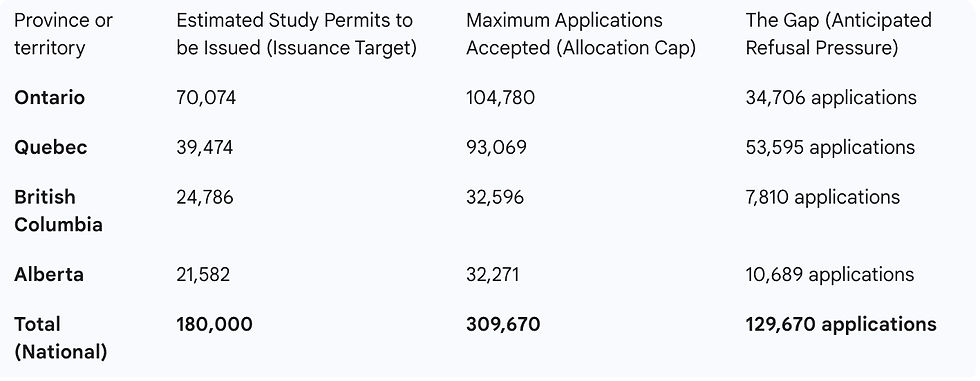
The Designated Learning Institutions (DLIs) within each province will determine how to distribute these limited slots. This implies that competition for popular schools and programs will become even more intense.
📌 Taking British Columbia (BC) as an example:
IRCC plans to accept 32,596 applications but only expects to approve approximately 24,786 Study Permits. The surplus of nearly 8,000 applications will face an extremely high risk of refusal! In other words, obtaining a PAL/TAL does not guarantee a study permit; the competition is relentless.

Major Exemption Categories: Highly Qualified Talent Unaffected by the Cap
To continue attracting top talent, the following groups of applicants will be exempt from the PAL/TAL requirement, meaning their applications are not subject to the provincial quota limits:
New Exemption: Master’s and Doctoral level students enrolled at a Public Designated Learning Institution (DLI).
Primary and Secondary (Kindergarten to Grade 12) students.
Existing study permit holders applying for an extension at the same DLI and at the same level of study.
⚡️ Immigration Consultant's Advice: Act Now to Prevent Delays
This latest cap policy is a significant warning for all students planning to study abroad.
For Prospective Clients Currently Considering Study:
You must seize the moment and take immediate action! The Canadian government's quota is fixed, and once the allocation is used up, it's over. The era of "slowly choosing schools and leisurely preparing applications" is finished.
Encouragement to Enroll Early:
Schools have limited PAL/TAL allocations and will prioritize students who are already admitted and have paid their tuition fees.
Encouragement to Submit Study Permits Early:
Only when your study permit application is submitted to IRCC can you secure an allocation spot. Once the allocation is exhausted, even with a school acceptance letter, you may be unable to apply due to the lack of quota.
We strongly recommend that the sooner you contact us at Withus Immigration, the faster we can complete your school enrollment, obtain the PAL/TAL, and submit your study permit application, preventing potential complications and delays and securing your optimal departure time!
For Students Planning to Depart in 2026:
🚨 Please start planning and acting now!
The entire 2026 quota is set and will be consumed starting in January next year. If you plan to depart in Fall 2026 (September) or even earlier, you must submit your study permit application early in 2026 to secure a spot before the quota tightens, ensuring your study plan and departure date are not affected.
👍 Withus Immigration Professional Service Commitment:
As your professional immigration consultant, we understand the pressure brought by policy tightening. We will:
Develop precise selection and application strategies, prioritizing DLIs that can quickly issue PAL/TALs.
Expedite the processing of your school enrollment and visa documents, striving to complete submission in the shortest time possible.
Provide targeted guidance on exemption policies, assisting eligible Master's and Doctoral students to apply directly.
Contact us immediately to let us help you seize the opportunity and ensure your path to studying in Canada remains unaffected by the quota!




Comments